
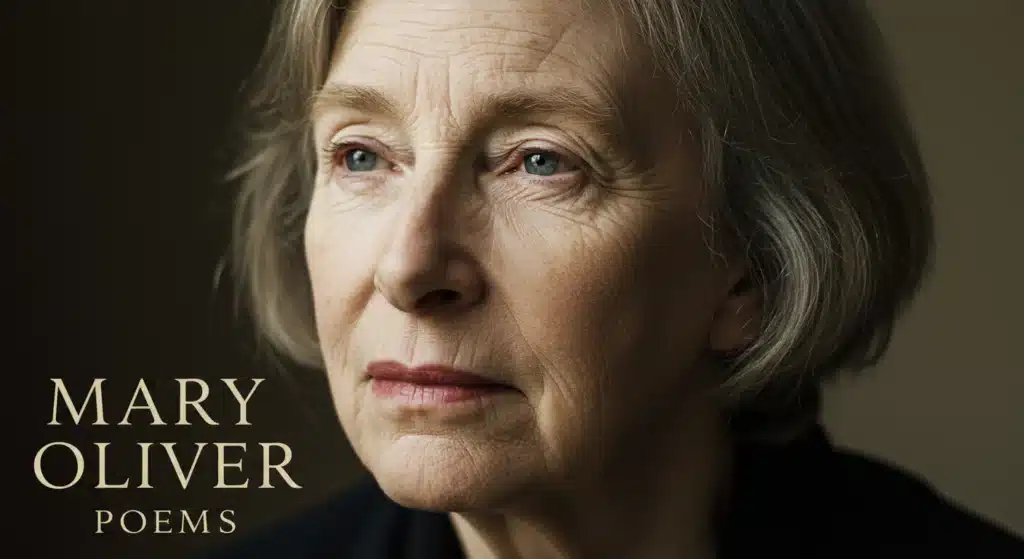
Mary Oliver’s poetry captures the essence of the natural world in a way that feels both intimate and profound. Her words invite readers to slow down, observe the beauty around them, and reflect on the simple truths of existence.
If you’ve ever wandered through a forest, gazed at the ocean, or listened to the wind rustle through the trees, Oliver’s work will resonate with you on a deeply personal level.
In this article, we’ll explore the life, themes, writing style, and some of Mary Oliver’s most impactful poems. Whether you’re a long-time admirer of her work or new to her poetry, this piece will offer insight into why her poems continue to move readers today.
Background: Who Was Mary Oliver?
Mary Oliver was born in 1935 in Maple Heights, Ohio, and her lifelong fascination with nature and animals became the cornerstone of her writing. Oliver was known for her straightforward style, her ability to communicate deep insights into life and the natural world, and for her quiet yet powerful voice.
Her poems are celebrated for their simplicity and clarity, yet they often touch on complex themes like spirituality, solitude, love, and the fleeting nature of life.
Oliver’s writing gained widespread acclaim, earning her the Pulitzer Prize for Poetry in 1984 for her collection American early and the National Book Award in 1992 for New and Selected Poems. Her work continues to be a touchstone for readers who seek solace and inspiration in nature.
Mary Oliver’s Writing Style and Recurring Themes
Mary Oliver’s poetry is often characterized by its simplicity and directness. She didn’t rely on complex metaphors or elaborate structures but instead used accessible language to convey profound emotional and spiritual truths.
Connection to Nature
One of the most striking aspects of Oliver’s work is her intimate connection to nature. Her poems often explore themes of the earth, the seasons, animals, and the human place within the natural world. She frequently writes about animals and plants as symbolic representations of human experiences, conveying complex emotions with the help of nature’s raw beauty.
Silence and Solitude
Many of Oliver’s poems explore the themes of solitude and the power of silence. She often speaks of finding peace and insight in moments of quiet reflection, suggesting that by listening carefully to nature, one can learn life’s most important lessons.
Life and Mortality
Oliver’s poems also grapple with the realities of life, death, and the passage of time. Her reflections on mortality are often hopeful, emphasizing the beauty and fleeting nature of life rather than focusing on its loss. In her view, life is something to be celebrated, even in its impermanence.
Spirituality and the Divine
While Oliver’s work is rooted in nature, it also contains spiritual themes. She often draws comparisons between nature’s beauty and divine presence, encouraging readers to find sacredness in everyday moments. Her spirituality is not dogmatic, but instead, it invites readers to form their own understanding of the divine through the natural world.
Poems and Their Meanings
1. Wild Geese
“You do not have to be good.
You do not have to walk on your knees
for a hundred miles through the desert, repenting.
You only have to let the soft animal of your body
love what it loves.
Tell me about your despair, yours, and I will tell you mine.
Meanwhile the world goes on.
Meanwhile the sun and the clear pebbles of the rain
are moving across the landscapes,
over the prairies and the deep trees,
the mountains and the rivers.
Meanwhile the wild geese, high in the clean blue air,
are heading home again.”
Interpretation: Wild Geese is one of Oliver’s most beloved poems. It speaks to the idea of self-acceptance and the universal human experience of suffering. The poem invites us to release the heavy burden of perfectionism, suggesting that we do not need to be “good” or “pure” to deserve love or peace. Instead, we are urged to embrace our authentic selves, imperfections and all. The wild geese, in their freedom, symbolize the idea of returning to one’s true nature.
Modern readers can connect with this poem because it speaks to the human need for self-compassion and the release of unrealistic expectations. In a world that often values achievement over authenticity, Wild Geese reminds us to simply love what we love and to let go of unnecessary burdens.
2. The Summer Day
“Who made the world?
Who made the swan, and the black bear?
Who made the grasshopper?
This grasshopper, I mean—
the one who has flung herself
out of the grass, the one who is eating sugar
out of my hand, who is gazing around with her enormous and complicated eyes.
Now she lifts her pale forearms and thoroughly washes her face.
Now she snaps her wings open, and floats away.
I don’t know exactly what a prayer is.
I do know how to pay attention,
how to fall down
into the grass, how to kneel down in the grass,
how to be idle and blessed,
how to stroll through the fields,
which is what I have been doing all day.”
Interpretation: In The Summer Day, Oliver poses big existential questions—”Who made the world?”—but ultimately shifts the focus to the present moment, capturing the grace of a grasshopper and the act of paying attention to the wonders of nature. The poem’s tone is meditative and peaceful, encouraging readers to slow down and notice the small, beautiful things in life.
The poem is a celebration of mindfulness, where the speaker contemplates both nature and spirituality, suggesting that perhaps true prayer lies in appreciating the world around us. In an age where people are often caught up in the rush of life, The Summer Day urges us to embrace moments of stillness and wonder.
3. The Journey
“One day you finally knew
what you had to do, and began,
though the voices around you
kept shouting their bad advice—
though the whole house
began to tremble and you felt the old tug
at your ankles.
“Mend my life!” each voice cried.
But you didn’t stop.
You knew what you had to do,
though the wind pried with its stiff fingers
at the very foundations,
though their melancholy was terrible.
It was already late enough, and a wild night,
and the road full of fallen branches and stones.
But little by little,
as you left their voices behind,
the stars began to burn through the sheets of clouds,
and there was a new voice
which you slowly recognized as your own,
that kept you company as you strode deeper and deeper
into the world, determined to do the only thing you could do,
determined to save the only life you could save.”
Interpretation: The Journey is about personal transformation and the courage to follow one’s own path, despite the resistance and expectations of others. The speaker describes the difficult process of leaving behind the “voices” of others—society’s demands, family pressure, or self-doubt—to embark on a journey of self-discovery and inner truth.
The poem’s imagery evokes a sense of struggle, yet the ending is empowering. The “new voice” that emerges represents the speaker’s inner strength and determination. In a world full of distractions and advice, Oliver reminds readers that the most important voice is their own.
4. When Death Comes
“When death comes
like the hungry bear in autumn;
when death comes and takes all the bright coins from his purse
to buy me, and snaps the purse shut;
when death comes
like the measle-pox;
when death comes
like an iceberg between the shoulder blades,
I will not ask you to wait,
nor will I ask you to forgive me.
I will die just as the bear will,
without knowing why, without understanding.”
Interpretation: In When Death Comes, Oliver explores mortality in a stark and unflinching way. The speaker reflects on death’s inevitability and the unpredictability of its arrival. There’s a haunting beauty in how Oliver compares death to various natural events, like the bear or the measles. The poem highlights the mystery and finality of death, reminding us that we can never truly understand it, but we must accept its presence.
This poem encourages readers to embrace life fully, knowing that death will come in its own time, beyond our control. It resonates today because it speaks to the common human fear of death and the desire to live meaningfully before it arrives.
Why Mary Oliver’s Poems Still Matter Today
Mary Oliver’s poems resonate with readers today because they offer a powerful reminder to reconnect with nature, be present in the moment, and embrace our vulnerability. In an era of constant distraction, her simple yet profound words encourage us to slow down, pay attention to the world around us, and find solace in the beauty of life.
Her work also speaks to universal themes—self-acceptance, mortality, and the quest for meaning—that remain relevant, no matter the time or place. Oliver’s gentle yet insightful voice serves as both a refuge and a call to action, urging readers to live with intention and to embrace the wonders of the natural world.
Frequently Asked Questions
1. What is Mary Oliver’s writing style?
Mary Oliver’s writing style is simple, clear, and deeply reflective. She often uses nature imagery to explore profound themes such as mortality, love, and self-discovery. Her poetry is known for its accessibility, as she doesn’t rely on complex language or metaphors but instead focuses on the beauty of everyday moments.
2. What is the main theme of Mary Oliver’s poetry?
The central theme in Mary Oliver’s poetry is the relationship between humans and the natural world. She often explores nature as a source of spiritual insight and healing, while also addressing universal human experiences such as love, loss, and self-discovery.
Conclusion
Mary Oliver’s poetry has left an indelible mark on the literary world, offering readers a chance to connect deeply with both the natural world and their own inner lives. Her poems continue to inspire and comfort, reminding us of the simple joys of existence and the importance of living authentically.
Whether you are familiar with her work or just discovering it, Oliver’s poems invite us all to pause, reflect, and find beauty in the present moment.